
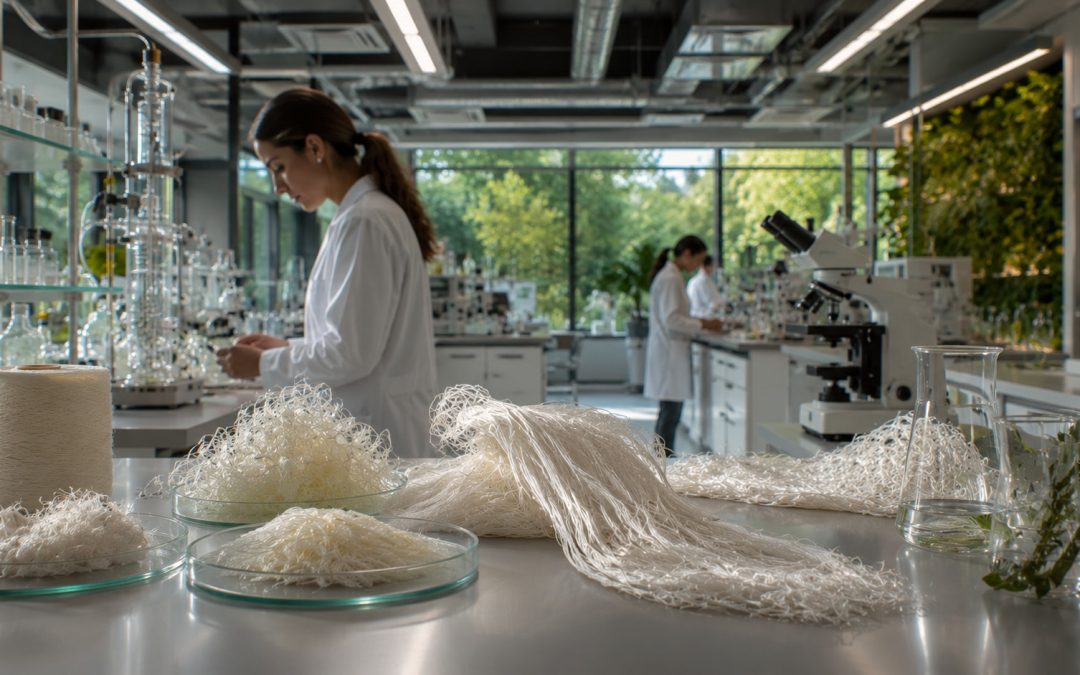
Performance by HM attended the talk Raw Materials Made in Portugal, organised by CENIT, where CITEVE, Agromethod Labs and Altri presented an update on the state of domestic textile raw material production. For European brands already producing, or considering producing, in Portugal, this matters for a concrete reason: it removes one more link of external dependency from the supply chain.
Cellulose and natural fibres made in Portugal
Carla Silva, Director of CITEVE’s Chemistry and Biotechnology Department, presented the Be@t project, which already allows the production of regenerated cellulosic fibres from wood and certified forest residues, some with added technical properties such as fire resistance. Portugal also has advanced trials of flax and hemp grown in the North and Alentejo.
“We have flax and hemp fibres entirely produced in Portugal,” said Carla Silva, currently at the industrial optimisation stage.
Cotton that grows without soil
One of the most original projects comes from Agromethod Labs: cotton grown indoors, without soil, through hydroponic systems. Raquel Maria, the company’s founder, explained that the resulting fibre is comparable to premium cotton and has already been validated across the whole chain, from fibre to yarn, all the way to a 100% hydroponic knit. The system allows continuous harvests throughout the year, with less water and no pesticides, still at pilot stage, with around 130 plants, but already showing potential for brands that value traceability.
From forest to shelf
Altri is converting part of its cellulose pulp production, currently mostly exported to China, into textile fibre made domestically. Gabriel Sousa, the company’s Executive Director of Innovation and Technology, said a demonstration unit will start up this year at Caima, with AeoniQ fibre, to test scale with clients.
What this means for those producing in Portugal
None of these projects is yet replacing imported cotton or polyester at volume. But they confirm a trend that matters directly to brands with production in Portugal: the Portuguese textile supply chain is getting shorter, end to end. That reinforces exactly the core argument for nearshoring, less dependency, more traceability, less exposure to external logistics shocks.
TAGS: Nearshoring, CITEVE, Agromethod Labs, Altri, Textile Fibres, Sustainability